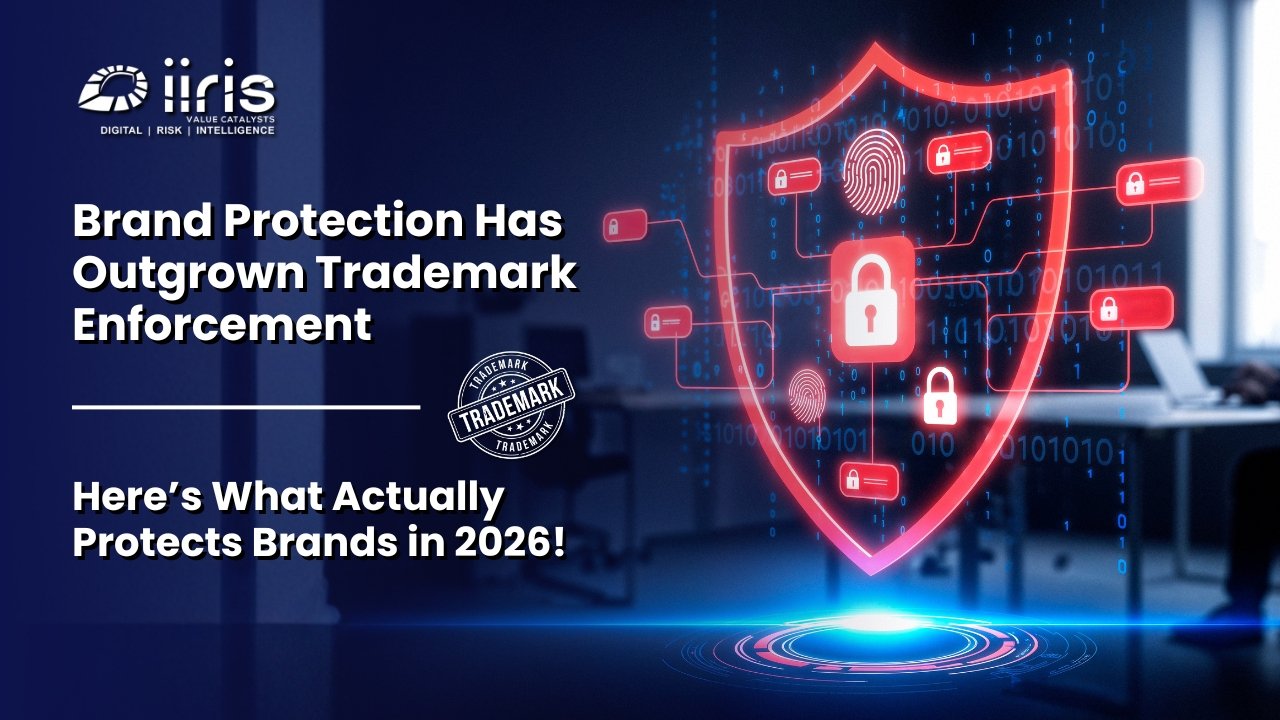
Ask most companies what ‘brand protection’ means, and you’ll get the same answer: register the trademark, watch the marketplaces, send a takedown notice when something infringing shows up. That answer was accurate five years ago. It is dangerously incomplete today.
The risk to brands in 2026 is no longer a counterfeit listing in the online marketplace of Amazon but rather a spoofed customer service chat that mimics your brand voice, an Instagram advertisement promoting an entirely fabricated product, a cloned website that deletes its trail of existence the moment an attempt is made to trace its origins, or a deepfake of your CEO’s endorsement on LinkedIn. Brand protection has silently morphed into an identity protection problem, and yet most enterprises remain unaware of this change in the threat landscape.
The challenge is not sophistication. It’s Volume
The current threat to brand protection isn’t the use of advanced AI-generated counterfeits; it is the sheer scale of it. The ease of e-commerce platforms and video-first platforms means that it has become incredibly simple for perpetrators to sell their counterfeit products before the enforcement teams can even get a clue. There are legitimate industry statistics that reveal the revival of the traditional tactic of selling counterfeit goods from standalone websites that use digital ad networks for promotion. And when it all goes wrong, the customer blames the brand, not the attacker.
With emergence of AI on top of this, the problem compounds in two distinct ways. First, generative tools let attackers scale fake storefronts, fake reviews, and fake influencer content at a volume manual enforcement simply cannot match. AI-generated voice and video have made it common to see executives impersonated in real-looking video content on professional platforms, exploiting the authority that comes with a leadership title. When a customer or partner can no longer reliably tell an authentic executive message from a synthetic one, trust doesn’t degrade slowly. It breaks the moment the fake is discovered, and it’s discovered publicly.
What this looks like in India specifically
For Indian enterprises, the enforcement terrain has real teeth, but it also has real gaps that attackers know how to exploit.
Legally, the Trademark Act of 1999 continues to be the most powerful tool; Sections 103 & 104 make falsification and false application of marks a criminal offence, while Section 29 deals with infringement through deceptively similar use in trade, advertising, or even imports and exports. Intermediary liability law has been made quite robust by the courts in cases such as Christian Louboutin v. Nakul Bajaj wherein the Delhi High Court ruled that e-commerce sites lose their safe harbour immunity once they start actively participating in either the promotion or sales of the infringing products. Also, in the Kent RO Systems v. Amit Kotak case, the court stated that the platforms need to act as soon as they are informed about any infringement and cannot just sit idle.
This is not a problem with the law but with the scope of enforcement. The counterfeiters and impersonators of India are shifting their operations into social commerce and private messaging platforms such as Instagram, WhatsApp, and Telegram. In doing so, any effort to remove the fake on one platform would have no effect, as it would resurface on another platform with only a minor change to its name a few hours later. In a mobile-first environment, fake apps are yet another underappreciated form of deception.
Enforcement built only around marketplace-reporting portals like Amazon, Flipkart, and similar brand registry-style tools protects a brand within that platform’s walls and nowhere else.
What a real brand protection strategy needs to cover now
Based on what we’re seeing across engagements, an effective program in 2026 has to work across five fronts simultaneously, not sequentially:
- Digital surveillance is in a constant state: From marketplaces, social media, private messaging channels, and mobile application stores, surveillance should move beyond the current set of platforms having enforcement portals.
- Identity protection, in addition to product protection: Watching out for identity theft, simulated endorsements, and social engineering through the use of deepfakes, is now firmly within the scope of brand protection, and not a separate cybersecurity issue.
- Coordinated legal action on all three fronts of India enforcement simultaneously: Civil cases filed under Section 134-135 of the Trade Marks Act, criminal cases filed under Section 103-105 (cognizable offences, in which case the police have the right to conduct a search and seizure upon obtaining the Registrar’s opinion), and Customs recordal to prevent counterfeit imports from entering the market.
- Offline investigation alongside online monitoring: Counterfeit networks now run hybrid operations, combining offline manufacturing and warehousing with online distribution, digital monitoring alone sees only half the operation.
- Speed as the actual metric of success: Most fraudulent storefronts and cloned sites operate for short windows before relaunching under a new identity, so the value of detection collapses fast if enforcement can’t move at the same speed.
Our View
Brand protection has evolved from being a legal activity aimed at responding to infringements into a constant cross-functional process that needs to keep up with the pace of threats. It is precisely those enterprises that treat brand protection as an annual renewal of trademarks or quarterly sweeps of the marketplace that learn about the issues when a client, reporter, or regulator learns about them first.
At IIRIS, we build brand protection programs the same way we build any risk mitigation capability, around continuous monitoring, coordinated legal response, and the recognition that in 2026, protecting a brand means protecting its identity everywhere that identity can be faked. That scope is bigger than it used to be. It has to be.
About the Author:
Akash Wigh is Assistant Vice President – IntelliRisk at IIRIS Consulting (Indus IntelliRisk & IntelliSense Services Pvt. Ltd.). A member of the Bar Council of Delhi with over nine years of experience across IPR enforcement, brand protection, legal advisory, and investigations, he leads structured interventions against counterfeiting and infringement risk and coordinates closely with government enforcement agencies on sensitive assignments.