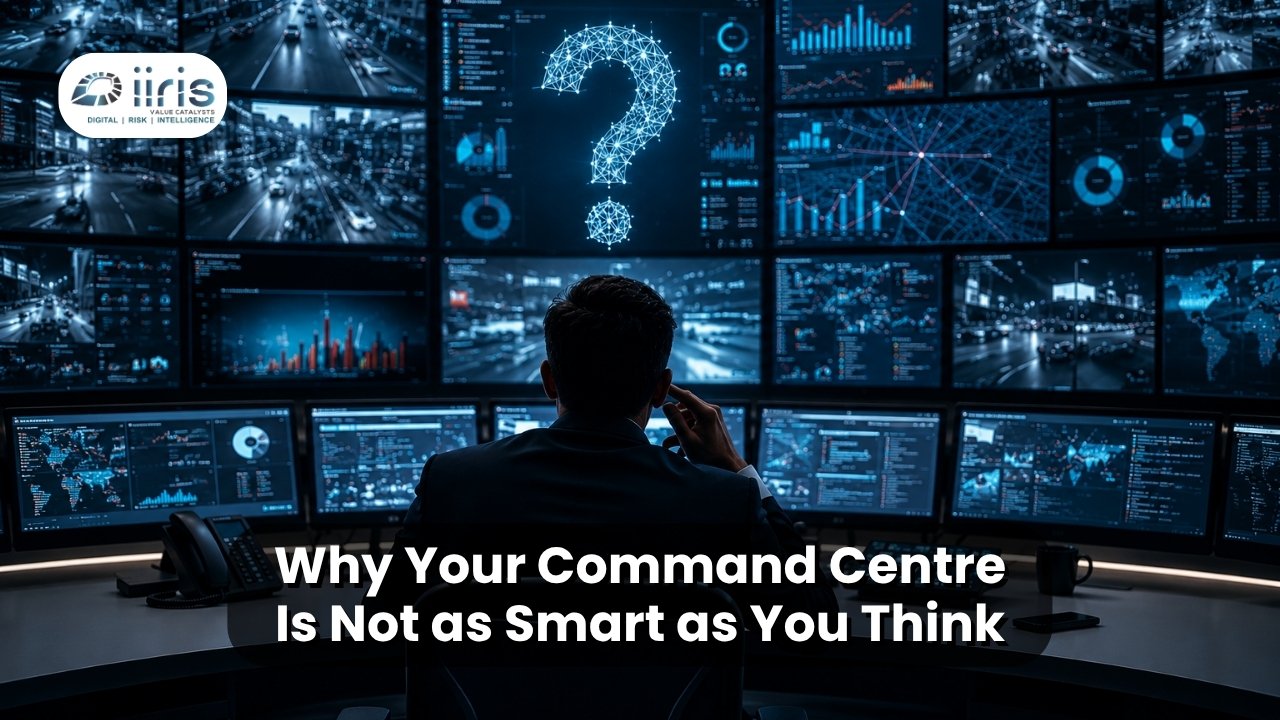
Walk into most command centres today, and the first thing that strikes you is the infrastructure. A wall of screens. Multiple camera feeds running simultaneously. Access control dashboards. Integrated alarm panels. A team of operators is watching it all unfold in real time. It looks exactly like what a command centre is supposed to look like.
But looking smart and functioning smart are two very different things. And in the gap between those two lies the most underexamined risk in enterprise security today.
The hard truth is that most command centres, regardless of the technology deployed, are not operating at the level of intelligence their design promises. They are monitoring systems dressed up as decision-support systems. And that distinction, seemingly subtle on paper, has consequences that surface exactly when you cannot afford them to.
A Gap that Most Organisations Haven’t Closed
The traditional command centres were built around a single function – ‘Monitoring’, where in action was only to observe and report. Cameras covered perimeters. Operators watched feeds. Alarms triggered responses. This was sufficient for the threat environment of a decade ago.
The reason was risks envisaged at that time. Most command centres were built as aggregation points, not analysis points. Operators respond to what they see. What they rarely do is what genuine intelligence functions require: correlation across systems, pattern recognition over time, and predictive flagging before an event materialises rather than during it.
This is the gap. And closing it is not primarily a technology problem. It is a design and doctrine problem.
The Five Failure Modes Nobody Talks About
In our experience designing and auditing command centres across sectors, from critical infrastructure to large-scale corporate campuses, five failure modes appear with striking consistency, irrespective of the technology in place.
1. Data richness without analytical depth
The average command centre receives more data than its operators can meaningfully process. Camera feeds, access logs, alarm events, patrol reports, visitor management data, and increasingly, cyber threat inputs, all flowing simultaneously. Without structured analytical frameworks and AI-assisted triage, operators default to reactive attention: they respond to what is loudest, not necessarily what is most significant.
2. System integration that stops at the interface
Many organisations invest heavily in integrating their security systems onto a single dashboard, and then assume the work is done. True integration is not about displaying multiple systems on one screen. It is about those systems sharing contextual intelligence. An access control anomaly that correlates with an unusual after-hours camera movement and a concurrent IT system login should trigger a unified alert. In most environments, each of these events sits in its own silo, reviewed independently, and flagged too late.
3. SOP-driven response in a non-SOP threat environment
Standard operating procedures are essential. They are also insufficient as the primary response framework for complex, evolving incidents. When operators are trained to execute SOPs rather than exercise situational judgement, command centres become rigid at exactly the moment flexibility is most needed. The best command centre doctrine combines procedural rigour with structured decision-making authority at the operator level.
4. Technology refresh without capability refresh
Organisations upgrade cameras, install AI-enabled analytics platforms, and add new sensors, often without a corresponding investment in operator training, doctrine update, or system recalibration. New technology layered onto old workflow produces marginal improvement at best. At worst, it adds complexity without adding capability and creates alert fatigue that makes the system less responsive, not more.
5. No stress testing
A command centre that has never been tested under simulated crisis conditions is not a command centre; it is a hypothesis. Tabletop exercises are valuable. Live simulations that tax the system, the team, and the inter-agency coordination channels simultaneously are what reveal where the doctrine actually breaks down. Most organisations run one without ever conducting the other.
What a Genuinely Intelligent Command Centre Looks Like
The word “smart” in the context of command centres should mean one thing: the ability to convert information into actionable intelligence faster than a threat can develop.
That requires four foundational elements working in concert.
1. Design that mirrors the threat model, not the technology catalogue
Command centre architecture should begin with a rigorous threat and vulnerability assessment, not with a shortlist of vendors. The design should answer the question: what are the specific scenarios this centre must detect, assess, and respond to? Every system, workflow, and staffing decision should flow from that answer.
2. True system integration at the intelligence layer
Not dashboard aggregation, but genuine cross-system correlation. Access control, surveillance, cyber monitoring, visitor management, and external threat intelligence feeds should communicate with each other, not merely coexist on the same screen. The command centre should surface relationships between events, not just events.
3. Operator capability that matches system sophistication
The most advanced command centre architecture underperforms without operators who are trained to think analytically, not just procedurally. Investment in human capability, selection, structured training, scenario-based exercises, and clear escalation authority is as important as investment in technology.
4. Continuous performance validation and Knowledge Management
Command centre effectiveness should be measured, not assumed. Key performance indicators around detection time, response time, false positive rates, escalation accuracy, and inter-agency coordination should be tracked, reviewed, and used to drive ongoing improvement. A command centre that is never audited against its own performance is not being managed; it is being operated.
Why This Is an Operational Risk Question, Not a Security Budget Question
Command centre performance is frequently framed as a security function concern. In reality, it is an operational risk concern that belongs at the COO level.
When a command centre fails to detect an early-stage incident, the consequences are not limited to the security team. Business continuity is affected. Regulatory exposure increases. Reputational risk crystallises. In sectors managing critical infrastructure, financial operations, or large public-facing environments, the downstream cost of a command centre failure can dwarf the investment required to prevent it.
The question for operational leaders is not whether the organisation has a command centre. It is whether that command centre would actually perform under pressure, and whether anyone has honestly tested that assumption recently.
If the answer is uncertain, the risk is already present. It simply has not manifested yet.
Final Thought: Intelligence Is a Design Choice
A command centre becomes smart not when it is equipped with the right technology, but when it is designed with the right intent, to anticipate, not just to observe; to correlate, not just to collect; to decide, not just to escalate.
That requires a deliberate approach to architecture, integration, human capability, and continuous performance validation. It requires organisations to hold their command centres to a higher standard than “it has not failed yet.” Because in security, the absence of a visible failure is not evidence of a functioning system. It is often evidence of a threat that has not yet chosen to reveal itself.
IIRIS Consulting designs and audits integrated command and control centres for organisations across India, the Middle East, and Africa, combining physical security architecture, AI-enabled surveillance, and intelligence-led operational frameworks to build command centres that perform when it matters most.
About the Author
Kunal Bhogal is a SABRE Registered Professional, with over two decades of experience in security design, command centre architecture, and technology integration. His work focuses on building intelligence-led security environments that enable better decision-making, operational resilience, and effective response. He has delivered major security projects across critical infrastructure, international airports, and FIFA stadiums in the Middle East.