She owned and operated a reputable trading company out of an industrial area in Maharashtra. She had clean GST registrations, worked with banks that made formal bank transactions with her, and had regular customers who kept coming back to her for business. Therefore, on paper, she would appear to be an ideal counterparty to do any business with.
On the other side was a recycling company positioned as a sustainability leader that focused on environmental sustainability and was powered by many institutions. It provided services to some of India’s biggest FMCG and automobile companies. It was this company that our client had approached us to conduct due diligence before making a substantial investment decision in it.
The following piece shares the journey that led us to something unexpected.
The Challenge: Not An Average Due Diligence Report
This was a case where our client was seeking more than a standard due diligence check. Rather than knowing how well a certain company had been filing its returns, they wanted to know whether the entire ecosystem surrounding it was as pristine as it appeared from the pitch deck.
Hence, we widened our scope beyond corporate and regulatory documentation. We conducted physical investigations of premises. We mapped their partners’ reality. That last step is where it got interesting.
The Target: A Company With All the Right Signals
There was an interesting story behind the company in focus for this exercise. A little over 10 years ago, it began as an inconspicuous partnership. Since then, it has grown into a multi-state plastic waste recycling operation with a product that has been registered as an Extended Producer Responsibility (EPR) Credit with the Central Pollution Control Board (CPCB). And now it counts a mix of institutional investors on the cap table, and blue-chip customers across the automotive OEMs and FMCG sectors.
They have exceeded INR 100 crores in revenue, have secured borrowings with lenders being content, and their employees have positive things to say about their management. Site visits substantiated that they had real machinery, people working in those machines, and actual operations related to their core business. This is not a shell of a business; it is a legitimate business. However, a business exists in the context of an “ecosystem”, and with ecosystems, there are shadows.
The Number That Demanded Attention
When we examined the breakdown of their revenue on the client-side, one entry jumped out at us. The largest client by far was a sole proprietorship trading under a fictitious name. This single entity alone represented almost 18% of all revenues during the financial year 2024-25, while in the previous year its contribution was barely 4%. This is not a small increase, and not a slow or gradual one either. Furthermore, there was no discernible reason for this rapid change in terms of the apparent size of this entity.
Anomalies do not equal accusations during due diligence processes. But they do point towards further investigations. And we did that.
What the Databases Failed to Reveal
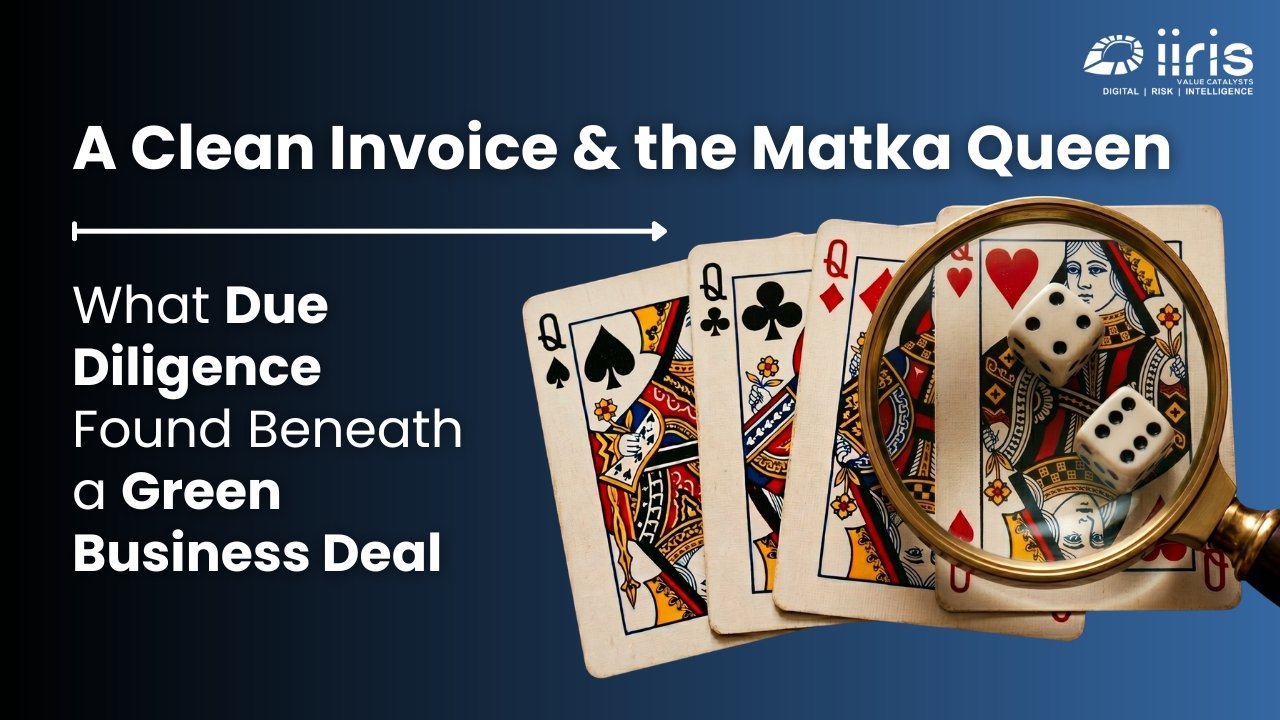
As standard due diligence revealed no issues, we did not stop there and delved into the judicial records. In doing so, we discovered that the owner had a criminal history dating back decades. As she had changed her surname on getting married, all these court records bore her married name. It seems that she had been found guilty of the murder of her husband, who was a person connected to the “matka” gambling racket in Mumbai.
The case dragged on for many years through the court system until a conviction was finally obtained. The conviction was also recorded. She had ultimately been granted bail on medical grounds after serving her time.
However, we weren’t finished.
The Second Chapter: Goa, 2025
Press archives uncovered some more information. During 2025, this very person had been arrested in Goa, involved in an operation related to illegal gambling. Reports described her as a well-known figure in this ecosystem.
This individual was buying INR 21 crore worth of goods each year from a company looking for institutional investment. There were two separate legal events involving one person in one recurring world: the matka network. This network, while declining during the rise of online betting, still operates through informal financial channels, cash flows, and networks outside the formal economy.
We identified this case as a panic response versus a reasoned, intelligence-driven response. Our role was not to prosecute but rather to present a full picture to a client.
Why This Case Is Relevant Beyond the Headlines
Our client received the results of our due diligence investigation before the finalisation of a term sheet, so that they were prepared and not surprised by this data once the agreement was executed. Although the transactions were legitimate, the associated risk was reputational or structural.
This is what deep due diligence results in. It is a time-consuming, multi-layered, non-glamorous approach to research, and can sometimes yield shocking results. This is also the only way you can ensure that the persons signing the cheque are protected.
Truth does not always lie within the complex financial structures of a company. In fact, sometimes it can be found in many different places; for example, court documents, local media, or even through the old names a person used to refer to themselves before they remodeled. Our experts will help you locate it.
Do you need deeper research before you finalize on a major transaction? Reach out to us at IIRIS Consulting for comprehensive, detailed due diligence that goes beyond the obvious through a professional and confidential process. Write to us at contactus@iirisconsulting.com